Posts

Bioprinting a Kidney: Hope or Hype

Image
Organ shortage remains as a global crisis with no sight of a decrease in demand. In the US alone, the current number of people on a waitlist for organ transplantation stands at over 120,000 and >83% are awaiting for kidney transplants [1] . Of those requiring transplants, only ~17% receive a kidney transplant, ~5% will die and the remaining 78% are still on the waitlist. Kidney transplants is not the end-all be-all Even if you were the lucky 13%, having a new transplant means you have to be on immunosuppresive drugs for the rest of their lives to minimize organ rejection and continue to be vigilant with their health. The other option For those who are less fortunate, which is the majority, they have to be on dialysis. This means you will have to go to a treatment center for hemodialysis every 2-3 days to get your blood filtered. For those who choose home-based treatment, either hemodialysis or peritoneal dialysis, this will have to be done everyday. Dialysis treatment affects ...

How can Bioprinted Tissue Models help develop drugs for COVID-19?

Image
Bioprinting Tissue Models The advent of bioprinted three-dimensional (3D) tissue models for drug discovery and development has been propelled by the lack of predictive in vitro systems and animal models for testing efficacy and safety of new drugs. Fortunately, as bioprinting tools have become more advanced and our knowledge-base continues to increase, the level of sophistication, precision and complexity of today's bioprinted tissue models are moving closer toward a reality - an in vivo like system that is representative of the human body ex vivo . Tissue models: Cancer progression on the skin Given how everything has been evolving and revolving around COVID-19, let's take a moment to highlight recent developments specific to bioprinting including ones that are targeted toward finding a solution for COVID-19. Tissue Models for COVID-19 Lung Tissue Model Last week, Viscient Biosciences announced that the company is leveraging their unique approach to bioprint...

Bioprinting the Lymph Node to generate antibodies against COVID-19

Image
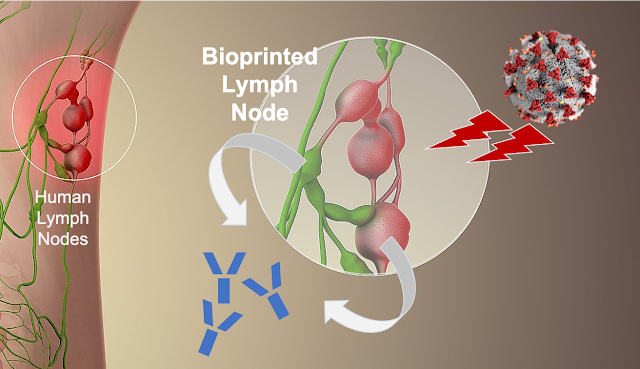
Bioprinted lymph node to generate antibodies against SARS-CoV-2 (credit to Prellis Biologics) Race against COVID-19 Since the pandemic, biotech and pharmaceutical companies are racing to develop diagnostic kits, vaccines and treatments to combat COVID-19. Antibodies, more specifically neutralizing antibodies that can bind to the virus, can help reduce and prevent infection against SARS-CoV-2. This can serve as a prevention for those of us who have not yet been infected or after recovery and reduce effects of those who are infected and in the road to recovery. Now, some of you might wonder, so how is bioprinting going to help create antibodies? Bioprinting a Synthetic Lymph Node  Enter Prellis Biologic s, a Bay Area early-stage venture backed bioprinting company who proposed that they can bioprint a synthetic mini lymph node that will induce immune cells to create human antibodies that are effective against SARS-CoV-2. The beauty of this approach is that there is no ne...

New materials for freeform (FRESH) Bioprinting

Image
FRESH bioprinting  The beginning Bioprinting of soft materials such as hydrogels have long been impaired by their inability to hold its own form, rendering them "unprintable". Thankfully, in 2015, TJ Hinton and Adam Feinberg published a Science paper introducing the idea of FRESH bioprinting. The term "FRESH" stands for freeform reversible embedding of suspended hydrogels and herein they introduced the idea of using a thermo-reversible support bath to enable in situ bioprinting of complex 3D biological structures. The beauty of this technique lies in the freedom to print complex structures including overhangs while being supported by the temporary gel bath. This breakthrough innovation has truly enable researchers around the world to bioprint complex and intricate structures out of soft biological materials such as collagen, thus pulling off additive manufacturing of realistic tissue models like never before. This video demonstration shows the FRESH printing...

Bioprinting bionic corals of the future

Image
Bioprinting algae? How it all began... In 2015, a group of researchers at the Institute of Food Technology and Bioprocess Engineering and the Center for Translational Bone, Joint and Soft Tissue Research at the Technische Universitat Dresden (TUD) in Germany introduced the idea of "Green Bioprinting". Using bioprinting, they immobilized microalgae in hydrogels made of alginate and methylcellulose, and demonstrated that they were able to achieve stable growth, in contrast to suspension cultures that were dependent on temperature and illumination conditions. Practical applications of this work would include bioproduction of photosynthetic microorganisms for renewable energy, chemicals or pharmaceutical drugs. To learn about this work -  read more . Today... Fast forward 5 years later, a group of researchers from UC San Diego and University of Cambridge showed how microalgae can be bioprinted to create bionic corals of the future - read more . By using a very unique approac...

Kickstart 2020 with a Beginner course in Bioprinting

Image
Curious about Bioprinting? Are you someone with a curious mind who has always wondered what bioprinting is all about? You may have heard about bioprinting over the news or came across an article describing all the amazing possibilities that this technology can deliver. Bioprinting full organs for future organ replacement. Is it true? Can this be real? To help people demystify these stories and get a grounded understanding of the technology, SE3D actually launched an online introductory course in bioprinting a few years ago. The first version was launched in 2018 and I have recently revamped the course, improved some of the content and recently launched this on Udemy. Within the first week, over 50 students have signed up as the first cohort and I love to see more interest. Bioprinting: A beginner course A quick nutshell of what you will learn in this course. This beginner course will cover the most basic concepts and provide key terminologies that are used in the bioprinting ...

Changing the face of 3D Printing, Biotech, and Additive Manufacturing with Dr. Shweta Agarwala

Interviewed by Cecillia Wong Dr. Shweta Agarwala is a research scientist at Singapore Centre for 3D Printing in Nayang Technological University . She combines her multidisciplinary knowledge in electronics, materials science, manufacturing and bio-engineering for materials and new-age products catering to wearables, flexible electronics and bioelectronics. She is a leading innovator in 3D printing and additive manufacturing space for electronics and biotechnology. Cecillia: Tell us about some of the exciting things your lab is currently working on. Dr. Agarwala: My current research is directed towards bioprinting, bioelectronics, and printed electronics. My rendezvous with bioprinting is quite new and I am trying to understand how process control can be exploited to arrange multi-materials in desired architectures and incorporate additional functionalities with full spatial control. I am especially passionate about bioelectronics, an area of research that promises to bring two dis...

What is a Lab-on-a-Chip?

Image
A lab-on-a-chip is a miniature device that allows the user to integrate several analyses such as DNA sequencing or biochemical detection on a low-cost chip. Lab-on-a-chip research mainly focuses on human diagnostics and biosensing. LOCs allow for reduction of cost through faster analysis of reagents and response time. This helps achieve high-throughput screening and automation of biochemical steps / processes onto a single device. Advantages of lab-on-a-chip devices are generally specialized to their application. Common advantages of LOCs are: waste reduction, efficient resource usage, increased process control, and quicker analysis and response times. Compared to normal experiments, LOCs utilize less sample volumes due to the use of microfluidics. This generates lower reagent costs. Microfluidic chips also allow for increased process control due to faster system responses (5) . The shorter diffusion distance also allows for rapid results, reducing response times and enabling faster...

Ethics of Bioprinting Organs: Can you put a price on life?

Written by Ria Bhatia Over the past three decades, the field of 3D bioprinting has emerged, creating endless possibilities for scientific progress. However, there are significant ethical dilemmas that come with this contemporary technology. One of the significant dichotomies in the bioprinting community is caused by those who support the idea of printing organs and those who do not. Throughout the history of organ transplantation, the process has been and continues to be vitiated by the lack of available organs and the long waiting lists for patients to receive a transplant. Currently, about 20 people die every day while on the waiting list [1] . Although it may seem as though bioprinting is the solution to the organ shortage epidemic, there are ethical concerns to this supposed panacea. When the first bioprinted organ is successfully manufactured, the question will arise: will this new technology only benefit the rich? This may very well be a reality of this nascent industry: b...

Bioprinting Industry Highlights of Q2 2018

New Methods   Researchers at UCLA, Harvard, UC San Diego, University of Santiago de Compostela, Brigham and Women’s Hospital, and Sharif University of Technology have collaborated to create a stereolithographic bioprinting platform capable of printing with multiple materials [1]. This novel device utilizes a digital micromirror device, a moving stage, and a microfluidic device with four pneumatic valves to rapidly switching between various bioinks for multimaterial printing [2]. The micromirror incorporates a UV lamp, digital mirroring device chipset, Keplerian optical setup, and a microscope objective to focus and adjust light intensity on a DMD chip [3]. The light beam is generated into different patterns on the chip using CAD. The microscopic objected focuses the selected pattern at the optimal length where photosensitive hydrogels can be be exposed to UV light to crosslink, solidify, and create complex structures [4]. While the bioprinter has successfully demonstrated printing...

Moving to a New Site

Dear Bioenthusiasts and STEM Advocates, Thank you following us through our three year journey with Blogger! As we've grown from a small startup sponsored by the National Science Foundation to the established company with a wide range of industry partners. SE3D has a commitment to bringing quality content in a timely manner. We have decided to change our bi-monthly blog to a weekly blog with new content focused on bioprinting industry highlights, researcher spotlights, Women In STEM, and biomaterials. It is with this transition that we have decided to focus solely on updating our blog on our website . Thank you for all your support. Don't worry, all the old content on Blogger will remain but you can follow our new content  here . Thank you, Team SE3D

Design Thinking and Bioprinting With Ohlone College

Image
Design thinking is an invaluable skill that incorporates holistic first-person perspectives with rational and analytical thinking to arrive at creative solutions. It is an effective approach to tackling complex business, social, and technological problems. When design thinking is applied to healthcare and medicine, it leads to an innovative solution that may be more effective than other methods. x The principles of design thinking can be summed up in five simple steps: 1.  Empathize  with the users 2.  Define  the user’s needs and problems along with your own insights 3.  Ideate  by challenging assumptions and create new concepts and thought processes 4.  Prototype  by creating different solutions 5.  Test  out all the solutions In early March, we collaborated with  Ohlone College  to run a special projects program for the  CTE Health Science Pathway . The purpose of the project ...

Bioprinting Industry Highlights of Q1 2018

Image
Cell-laden hydrogel microgrids x New Methods A team from the University of British Columbia (UBC) Okanagan campus has developed a new technique called direct laser bioprinting (DBLP), which allows researchers to print living tissues instrumental to cancer research. This method entails utilizing a laser diode to photo-crosslink at a wavelength of 405 nm, enabling researchers to print artificial tissues at an unprecedented resolution and level of precision [1]. The tissues printed using this method can also sustain living cells with an unparalleled 95% effectiveness, meaning that cells can successfully survive on the engineered tissue structures [2]. The UBC team postulated and determined that DBLP can be utilized in “cell-laden hydrogel microgrids, hydrogel microwells, cell seeding, and cell encapsulation,” [3] adding to its appeal as a key innovation. According to lead researcher Dr. Keekyoung Kim, these findings have numerous potential applications, “from helping people sufferi...

Beginners Guide to Bioprinting: Alginate as a Biomaterial

Image
Here is the 2nd blog to our series of beginners guide to bioprinting. The purpose of this guide is to provide basic knowledge in a topic of interest in the field of bioprinting. This blog will feature the use of alginate as a biomaterial for bioprinting. Alginic acid, or more commonly known as alginate, is probably one of the most commonly used and versatile hydrogels for cell encapsulation, cell culture, and tissue engineering. Its biocompatibility and simple cross-linking / gelation chemistry makes it ideal for encapsulating cells. In addition, chemical modifications can be made on the polymer chain to promote cell adhesion and cell growth. Stay tuned to more educational beginners guides to bioprinting featuring other biomaterials like collagen and pluronic. To view or participate in our webinar series, click here . In this blog, we will discuss how alginate has been used for bioprinting. What is alginate? Alginate is an anionic polysaccharide derived from b...

Educator Spotlight: Adelle Schade

Image
Why it is important to bring bioprinting technology into the classroom? One of SE3D’s core values is to share our technology with the education community, democratizing bioprinting technology to spur new innovations across all levels. Bioprinting is important because it is a cornerstone technology that can provide transformative solutions in healthcare such as organ printing and tissue regeneration. In order for us to be successful in bringing bioprinting into the classroom, we need passionate teachers like Ms. Adelle Schade to deliver this opportunity to her students. I met Adelle at the ISTE (International Society for Technology in Education) conference in Philadelphia back in 2015. The very first time we met, Adelle only saw the “concept” prototype of our r3bEL bioprinter, but when I explained to her what bioprinting and SE3D is about, she immediately got what we were trying to do. On the following day, she came back to our booth with fellow teachers and friends. I could alread...

Open-Source 3D Software Programs

Image
Why we chose open-source 3D software programs One of SE3D’s core principles is to provide a seamless user experience: we chose to focus on designing with the user in mind. When we first started designing the r3bEL (pronounced as “rebel”) bioprinter, we carefully considered what our users needed and how they would use our bioprinter to enhance their research or educational goals. We opted to use open-source 3D software programs, such as Pronterface and Slic3r, because there are many great advantages for our end-users to leverage these open-source programs. 1. It is FREE Who doesn’t like free products and services, especially when the quality is not compromised? Rather than focus on developing a new program, we sought to invest our time in end-user development and dedicate our time to creating customer resources such as curriculum and protocols. We also found that many open-source 3D software programs available were more often than not one of the best ones. 2. Crowd...