Posts

Bioprinting and Biofilm Mimicry: A Student Science Adventure

Image
Biofilms Biofilms, complex extracellular structures created by bacterial colonies, pose a serious threat to human health. They are responsible for survival and antibiotic resistance of many bacteria, and lead to serious infectious diseases such as cystic fibrosis and endocarditis. Preventing or destroying biofilms is an important area of research, and could help cure these diseases. A major challenge in studying biofilms is our ability to create them reproducibly and precisely in the laboratory so that experimental results are reliable. The r3bEL Bioprinter can mimic biofilms through culturing and printing bacteria in an alginate medium onto a petri dish or another substrate. These highly reproducible biofilm mimicries can then be tested for effects of key variables  and of antibacterial substances. About me I am Shruteek Mairal, a sophomore at Irvington High School in Fremont. Science and technology have always fascinated me, and in the spring of 2016, I came to k...
Super Scary Superbugs

Superbugs refer to strains of bacteria that cannot be killed using multiple antibiotics. Per the CDC (Centers for Disease Control and Prevention), roughly 2 million people get sick from superbugs every year and about 23,000 of them die. An elderly American woman died in the US recently after having contracted an infection while being treated for a thigh bone fracture in India two years ago. Tests showed no drug or combination of drugs available in the US would have cured the infection. But where did these superbugs come from and why are they a problem now? Origin Antimicrobial resistance (AMR) is the ability of a microbe to resist the effects of medication previously used to treat them. It is a result of misusing antibiotics and evolution at work. Misusing antibiotics is when antibiotics are taken when they aren’t needed or not finished when they are needed. This leads to antibiotics becoming less effective for future bacterial infections and the development of antibiotic resis...

3D Printed Food: A Taste of Science

Image
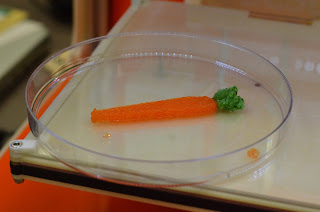
Appetizer There has always been a marriage of food and science throughout history. Before modern biotechnology was used to produce desired traits in plants and animals, farmers would raise and breed livestock that produced the most milk or best marbling. Food scientists also help determine each ingredient’s optimal condition for harvesting, preservation, and cooking.  From molecular gastronomy to chocolate printing, science has radically changed how we cook, present, and taste food. Entree 3D printers and bioprinters are revolutionizing the food industry by unlocking unlimited potentials for taste, touch and sight. 1.     Taste 3D food printers with specific focuses are already in circulation such as the successfully crowd-funded Pancakebot or Bocusini. 3D printing food does not require any sacrifices in taste. In fact with the help of several techniques from molecular gastronomy, 3D printed food has the potential to taste even better than regula...

What does 3D printing bring to future kitchens?

Image
BY MAYASARI LIM, PH.D. The Technology  Additive manufacturing has really transformed many areas of our lives today from desktop 3D printers to food printers that could produce custom designed personalized nutritional meals in every home one day. This month, our team has decided to take a closer look at the evolution of Food Printing. As far as food printers go, the use of additive manufacturing techniques spans from the basic extrusion based systems to powder and liquid binding deposition techniques. This allows the end-user to leverage the different material properties to achieve simple to complex shapes that can be created using each technique. In extrusion based food printers which may or may not involve melting, common materials that can be printed are typically soft materials like cheese, peanut butter, dough and chocolate which requires melting. One of the key challenges in this approach is the need for materials that are being printed to be viscous enough to hold its...

My 3D printer can bioprint... right? NOT

Image
Ear scaffold printed by r3bEL bioprinter Plastic widget printed by a typical 3D printer By Mayasari Lim, Ph.D. When the r3bEL from SE3D is on display at CES , NSTA or other educational events focused on STEM, the first impression is that it’s another 3D printer like those manufactured by MakerBot or Dremel . As you move in closer and notice that there is no spool for filament, one becomes a bit puzzled and asks the question, “Dr. Lim, this is a 3D printer right?” In some ways but its features and applications are very different than the 3D printers most educators are familiar with. While the r3bEL may have the basic physical structure and platform resembling a 3D printer, it has certain distinct features that cannot be produced in 3D printers typically found in schools. The r3bEL is actually classified as a “bioprinter” for the following; F ACT #1 – It does not print plastic! Most desktop 3D printers like MakerBot are based on fused deposition ...

SE3D Education Launches Science Lab Innovators Program

Image
Leading educational initiatives and innovation in science,  SE3D  Education has launched its 2017 Science Lab Innovators Program (SLIP). The  S LIP Program is comprised of select teachers in K-12 charter, public, and private schools, vocational training institutions, colleges and other related programs who are pioneering   bioscience-focused education through  innovative curriculum and lab programs. “It is our mission, with the support of the  National Science Foundation  (NSF), to stimulate interest in science through experiences that prepare and propel the next generation of biomedical scientists, engineers and innovators” stated Dr. Mayasari Lim, CEO at SE3D Education. “The Science Lab Innovators Program (SLIP) is our way of accentuating the S cience  in STEM by bringing together talented educators, initiatives and ingenuity to pursue that mission. We are very excited to offer this program for 2017” Participants in the SLIP program wi...

SE3D Partners with Nepris for Professional Development Programs

Image
SE3D Education is excited to be partnering with Nepris to teacher development webinars on how 3D bioprinting can be used in science classrooms for applications in biotechnology, green technology, and food science.  Nepris is a cloud-based platform that connects industry professionals into classrooms bringing relevance and application into curriculums. Dr. Mayasari Lim, CEO of SE3D will explore how this innovative tool enhances the learning experience of students to stimulate interest in science. This session is especially helpful for teachers and educators who are exploring how this technology is applicable to STEM, NGSS and CTE initiatives.  This session will be held Thursday, December 1 at 1pm PST/4pm EST. If you are interested in participating, please select this link  http://zurl.co/7ypb   to sign-up.