Posts

Spirulina: The Ultimate Superfood

Image
Spirulina is an organic superfood that eliminates diseases, reduces cholesterol, and energizes you. If losing weight or eating healthy is important to you, then spirulina is something you might want to look into. Spirulina was originally found and utilized by Aztecs in the 16th century and later rediscovered in Lake Texcoco by French researchers. It is high in protein, and carries many important antioxidants and vitamins, such as Vitamin B-12 and iron. Unlike many other superfoods, fresh spirulina is odorless and nearly tasteless, making it a great addition to almost any food. In a recent SE3D  experiment , spirulina was mixed with chocolate to create a superfood chocolate print that was indistinguishable from a normal print. Furthermore, it is extremely affordable to buy. Grown on a farm or taken from a lake, this algae is not in short supply. It has no harmful side-effects and is a natural appetite suppressant. Recently, Robert Henrikson opened the first spirulin...

Best 3D Chocolate Printers of 2017

Image
With the growing popularity of food printers, there is no surprise that a market for 3D Chocolate Printers. We review the pros and cons of the different chocolate printers that are currently on the rise using our intimate knowledge of  chocolate printing . Model:  Chocabyte 3D printer Why you should buy it:  Great value for price Who it’s for:  Beginners with limited or no 3D printing knowledge Pitfalls:  Limited to only 500 units Price Point:  $99 The Chocabyte 3D printer, which debuted at CES 2014, is a marriage of handiwork between designer Quinn Kataitiana and Solid Idea. Limited to just 500 units, the Chocabyte printer is hand-crafted and priced at an astonishing $99. There are currently no other chocolate printers in the market at this price point. No CAD knowledge is necessary as Solid Idea offers a library of chocolate printing templates. Chocabyte runs on a syringe based system which can be purchased from the website. Th...

BIOPRINTING INDUSTRY HIGHLIGHTS OF Q3 2017

Image
New Methods  A new method in bioprinting has been developed by an Oxford University spin-off company, OxSyBio, that will enable researchers to print and arrange cells in pre-determined 3D architectures. This novel method leverages the use of a lipid coating which encapsulates cells within protective nanolitre droplets during the printing process. Dr Alexander Graham, the lead author and scientist of OxSynBio, demonstrated the application of this technique with human embryonic kidney (HEK) cells and ovine mesenchymal stem cells (hMSCs). He was able to achieve high-resolution 3D geometries in the range of less than 200 microns while maintaining high cell viability. Learn more about this exciting work at their Nature publication –  Scientific Reports .  New Materials  In the most recent development, a clay-based bioink was developed and shown to provide improved drug delivery properties. A t...

Beginners Guide to Bioprinting: Pluronic as a biomaterial

Image
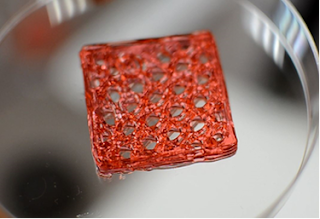
Here is the first blog to our series of beginners guide to bioprinting. The purpose of this guide is to provide basic knowledge in a topic of interest in the field of bioprinting. This blog will feature the use   of Pluronic as a biomaterial for bioprinting. When using r3bEL to print cellular scaffolds, Pluronic F-127 has been our favored biomaterial. Pluronic, also known as Poloxamer 407, is a hydrophilic non-ionic surfactant,[1] It is also a thermo-reversible hydrogel, meaning that it can change from liquid to solid state depending on the temperature, and in this case, it is a liquid at cold temperatures and a solid at room temperature. Pluronic is widely used in multiple fields due to its surfactant properties which allow for a lower surface tension between lipids and liquids. In the cosmetics industry, it is used in dissolving oily ingredients in water. Pluronic acts as a cleaning agent to safely remove lipids from the lens films in contacts solution. Pluronic i...

CEO of SE3D featured at IEEE WIE Disruptive Technology Virtual Track

Image
Check out this recently published virtual track featuring SE3D's own founder and CEO, Dr. Mayasari Lim and fellow woman entrepreneur Laura Stewart, CEO of VideoFizz. Female founders in STEM shared their journey about starting their own companies and struggles each have faced growing their business.

Bioprinting and Biofilm Mimicry: A Student Science Adventure

Image
Biofilms Biofilms, complex extracellular structures created by bacterial colonies, pose a serious threat to human health. They are responsible for survival and antibiotic resistance of many bacteria, and lead to serious infectious diseases such as cystic fibrosis and endocarditis. Preventing or destroying biofilms is an important area of research, and could help cure these diseases. A major challenge in studying biofilms is our ability to create them reproducibly and precisely in the laboratory so that experimental results are reliable. The r3bEL Bioprinter can mimic biofilms through culturing and printing bacteria in an alginate medium onto a petri dish or another substrate. These highly reproducible biofilm mimicries can then be tested for effects of key variables  and of antibacterial substances. About me I am Shruteek Mairal, a sophomore at Irvington High School in Fremont. Science and technology have always fascinated me, and in the spring of 2016, I came to k...

Super Scary Superbugs

Superbugs refer to strains of bacteria that cannot be killed using multiple antibiotics. Per the CDC (Centers for Disease Control and Prevention), roughly 2 million people get sick from superbugs every year and about 23,000 of them die. An elderly American woman died in the US recently after having contracted an infection while being treated for a thigh bone fracture in India two years ago. Tests showed no drug or combination of drugs available in the US would have cured the infection. But where did these superbugs come from and why are they a problem now? Origin Antimicrobial resistance (AMR) is the ability of a microbe to resist the effects of medication previously used to treat them. It is a result of misusing antibiotics and evolution at work. Misusing antibiotics is when antibiotics are taken when they aren’t needed or not finished when they are needed. This leads to antibiotics becoming less effective for future bacterial infections and the development of antibiotic resis...